R.D. Banerji (1885-1930), an Indian Archaeologist from the Archaeological Survey of India based on the travelogues of monk pilgrims Faxian (Fahien, 5th CE) and Xuanzang (Hsüan-Tsang, 7th CE) in 1906 identified the Gurpā Hill (Gaya District, 25° 32’ 57 N, 85° 18’ 13 E) as the site of Kukkuṭapādagiri. As per the tradition, it is here at Kukkuṭapādagiri (Cockfoot’s Mountain) /Gurupāda (Teacher’s Feet) that the sleeping sage Kāśyapa (Mahākassapa/Mahākāśyapa), waiting for the future Buddha, the Maitreya (Huard 2020: 8).
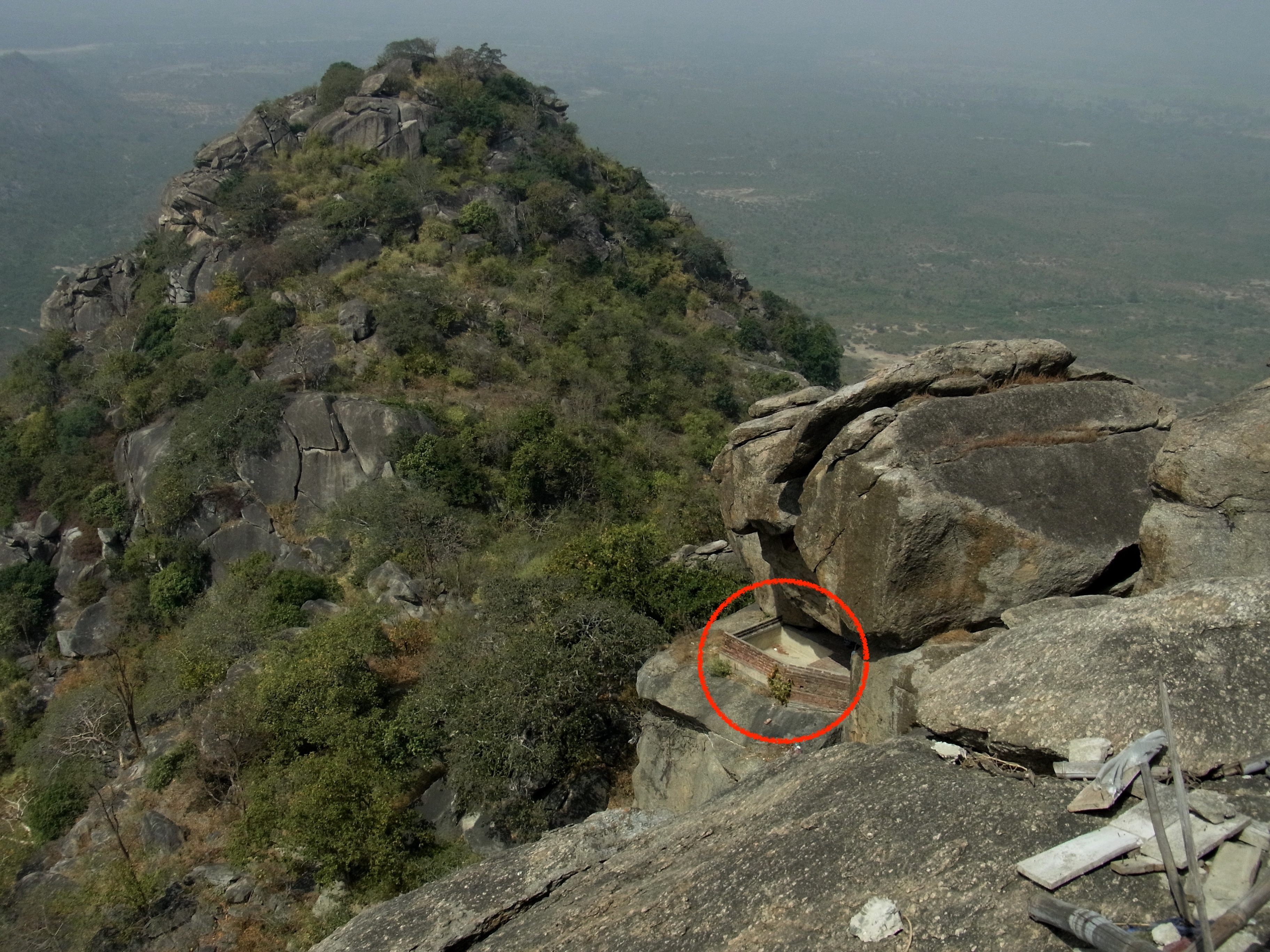
Banerji on his visit to Gurpā Hill (Kukkuṭapādagiri) in 1906 noticed a rectangular 8ft X 5ft tank with a single step running along its four sides. Shri Babu Dayal Gupta, guard of the East Indian Railway informed Banerji that this tank was covered with a huge piece of stone. The stone was removed by order and in the presence of Mr F.E. Cockshott, the Engineer-in-charge of the new railway line, inside was found a skeleton more than 6ft in length.
 |
| 'Mahākassapa Sarcophagus', 8ft X 5ft tank with a single step, Kukkuṭapādagiri. |
 |
| 8ft X 5ft tank with a single step encircled in red, Kukkuṭapādagiri. @Yves Guichard
|
 |
| 8ft X 5ft tank with a single step encircled in red, Kukkuṭapādagiri.
|
 |
| 8ft X 5ft tank with a single step encircled in red, Kukkuṭapādagiri. |
An obvious question is whether the skeleton discovered on the Gurpā Hill belonged to Mahākassapa. Let us explore what the Buddhist literature says about the nibbāna (nirvāṇa) of Mahākassapa. There are numerous texts in the Theravāda tradition (Pali literature) and in the Northern tradition (Sanskrit literature) that have mentioned the legend of Mahākassapa’s Nibbāna. Highlighting a few of the texts below:
1. Aśokāvadāna (narrative of Aśoka), a 2nd CE text which contains legends and historical narratives of king Aśoka (3rd BCE) mentions the visit of Aśoka to Kukkuṭapādagiri. Two hundred years after the Mahāparinirvāṇa of the Buddha, Aśoka became king of the Indian subcontinent and dedicated his life to the spread of the Buddha Dhamma. Aśokāvadāna describes how King Aśoka under the guidance of the monk elder Upagupta paid a pilgrimage to the stūpa of Mahākāśyapa (Strong 1983: 254). Aśoka made an offering of gold coins to the stūpa and enunciated:
I honour the elder Kāśyapa who dwells hidden inside the mountain; serene, his face turned away from strife, devoted to tranquillity, he has fully developed the virtue of contentedness.
Aśokāvadāna makes it evident, that the Mahākāśyapa was still dwelling inside the mountain (Kukkuṭapādagiri).
2. According to the Kṣudrakavastu of Mūlasarvāstivāda-Vinaya, Mahākāśyapa decides to enter parinirvāṇa and wants to visit Ajātaśatru but cannot achieve it because the king is sleeping. He then goes to the Kukkuṭapāda mountain, makes the vow with his adhiṣṭhāna ‘controlling power’ that his body, with his robe (saṃghāṭī) and stock, will be preserved until the time of Maitreya and lastly enters parinirvāṇa. Ajātaśatru, coming too late is informed by Ānanda of the future of Kāśyapa (Huard 2020: 28). Ajātaśatru, when he understood that Mahākāśyapa was dead, started gathering firewood to burn the body. Ānanda stopped him, saying: ‘Kāśyapa will keep his body as it is through the power of meditation until Bodhisattva Maitreya is reborn on Earth’ (Huard 2020: 30).
Another tradition, placed in the Bhaiṣajyavastu of Mūlasarvāstivāda-Vinaya, tells that Maitreya will come to the Kukkuṭapāda mountain with his disciples, take the skeleton (asthisaṃghāta) of Kāśyapa with his hands, and answer to the contempt of his disciples by (Huard 2020: 28).
Both the traditions of Mūlasarvāstivāda-Vinaya have a different story. While Kṣudrakavastu is ambiguous and does not explicitly state in which state the body of Mahākāśyapa should be preserved, in Bhaiṣajyavastu, Mahākāśyapa is displayed as a skeleton.
3. Sāvakanibbāna, the Pali text collecting deaths of saints has the legend of Kāśyapa. The lore in Sāvakanibbāna is also based on the Mūlasarvāstivādin tradition, more precisely on the Kṣudrakavastu (Huard 2020: 32-33).
‘The body of the Elder is still the same until now. Until Metteyya, the completely enlightened one, will arise in the world, it will not be destroyed, it will not be scattered, it will not show putrefaction. In the future, the noble Metteyya, the completely enlightened one, arisen in the world, will himself burn the body of the Elder in the palm of his own hand. Then, the lord of the world Metteyya will in this very place make a stūpa for the relics of the Elder to be honoured by the people.’
Similarly, in another medieval Pali text, called Mahāsampiṇḍanidāna, akin to the same tradition, Kāśyapa takes three resolutions (adhiṣṭhāna), beginning with: ‘May my dead body remain without decay in between the three peaks of the mountain Kukkuṭasampāta’ (Huard 2020: 33).
4. According to the Sarvāstivādin tradition, Kāśyapa died at the time of Śākyamuni (the historical Buddha) and only his body was preserved in the mountain (Huard 2020: 29).
5. The Sūtra on Maitreya’s Birth (Sūtra on Maitreya's Descent and Rebirth Below, as Preached by the Buddha; T no. 453), translated into Chinese around 313-317 CE by the Chinese monk Dharmarakṣa, says that the Buddha had instructed Mahākāśyapa to wait for Maitreya’s appearance into the world to transmit Sakyamuni's robe to him. Therefore Mahākāśyapa should live inside a mountain in a ‘cavern of meditation’ where the future Buddha will find him and then be revealed to the people. Among the witnesses of these prodigies many will attain arahantship. Mahākāśyapa will deliver the robe that the Buddha Gautama had given to him to Maitreya, and after that his body will disappear in flames (Lagirarde 2006: 89).
6. As per the Braḥmahākăssapatheraḥnibbān, a Pali text from Thailand, after reaching the Kukkuṭapādagiri mountain, Mahākassapa performs miracles and gives final preaching to the assembled monks and dignitaries. Thereafter he goes to the middle of the three peaks where his funeral bed has been installed. They will constitute a closed chamber inside the rock of the mountain itself, like a splendid sleeping room at this propitious moment. Mahākassapa thereafter attained anupādisesaparinibbāna i.e. there cannot be any physical continuation in the future. At the very moment when Mahākassapa entered nibbāna the three mountain peaks closed together. The text further mentions that Metteyya, the future Buddha will come to the place where Mahākassapa is buried. He will take Mahākassapa’s body in his hands, explain to his followers who he was and, after that, the body will burn to ashes by itself. In the royal palace, King Ajātasatrū learns the news of nibbāna of Mahākassapa. After nearly dying of grief, he goes to the mountain, which opens up, allowing him to see Mahākassapa’s body (Lagirarde 2006: 86-87, 99-101).
7. As per the Mahāprajñāpāramitāśāstra, a Sanskrit text attributed to Nāgārjuna has the following narrative structure (Lagirarde 2006: 88-89).
Mahākāśyapa goes to the mountain gives a final preaching and performs miracles;
Mahākāśyapa makes a wish: his body should not decay and it will be visible during the time of the future Buddha;
Mahākāśyapa goes inside the mountain and enters nirvāṇa;
The text gives a prediction about the time when the Buddha Maitreya will come into the world. The future Buddha will go to the Gṛdhrakūṭaparvata and knock on the mountain. The skeleton of Mahākāśyapa will appear, prostrate itself before the Buddha, and fly into the air. Then it will burn by itself.
Though Mahāprajñāpāramitāśāstra says that Maitreya will see Mahākāśyapa on Gṛdhrakūtā (Vulture Peak) rather than on Kukkuṭapādagiri, the importance of Mahākāśyapa is unmistakable.
8. A broken sculpture from the medieval period (8th-12thcentury CE) with an inscription mentioning the historic event of the ‘Exchange of Robes’ between the Buddha and Mahākāśyapa was discovered at Silāo (on the road from Rājgir to Nālandā) suggesting it Silāo to be the place where the Buddha exchanged his robes with Mahākāśyapa. The inscription provides a brief biography of Mahākāśyapa and concludes by saying that he ‘.....entered nirvāṇa on the charming hill of Gurupāda’ (Chhabra 1985: 327).
 |
| The cave where the Mahākāśyapa took Samādhi opened before venerable Ānanda and Ajāshatru. Both venerated Mahākāśyapa. Illustrated in Ming Woodcuts [Line drawings from Shih-shis yüan-liu (Origin of the Buddha) compiled from several Sūtra-s by Monk Pao-ch’eng during the Ming period (1368–1644 CE)] |
The eyewitness accounts of Faxian and Xuanzang who paid pilgrimage to Kukkuṭapādagiri have documented the tradition of the place at the time of their visit. According to Faxian, the entire body of Mahākāśyapa is preserved in a ‘receptacle’ in a deep chasm in Gurupāda (Beal 1869:132) probably alluding to some sarcophagus. According to Xuanzang, Mahākāśyapa ‘stands holding Buddha’s robe’ inside the Kukkuṭapādagiri mountain. The threefold summit has closed over him by the force of his prayer (Watters 1905; 144). Xuanzang continues to state,
Hereafter when Maitreya has come, and has had his three assemblies, there will remain an immense number of unbelievers; these Maitreya will lead to this mountain and shew them kāśyapa; but the sight will only increase their pride of spirit. The kāśyapa will in presence, give over the Buddha’s robes to Maitreya and bid him farewell; having done this he will soar into the air, work miracles, and pass away by magic combustion. (Watters 1905: 146)
All the ancient Buddhist texts, Pali, Sanskrit and the eyewitness accounts of pilgrims have maintained that the body of Mahākassapa is preserved in the Kukkuṭapādagiri. In my view, the plethora of substantiation leaves no room for doubt that the skeleton found in the tank belonged to Mahākassapa. Banerji believed in the stories shared by Babu Dayal Gupta because according to Banerji, Gupta had very little information about Xuanzang or Mahākassapa (Banerji 1906: 83). Banerji noticed many ancient Buddhist sculptures of different sizes near the tank suggesting the sanctity of the ‘tank’.
 |
| A new shrine in front of the Mahākassapa
Sarcophagus (8ft X 5ft tank). |
 |
Ancient Votive Stūpa, Kukkuṭapādagiri. |
 |
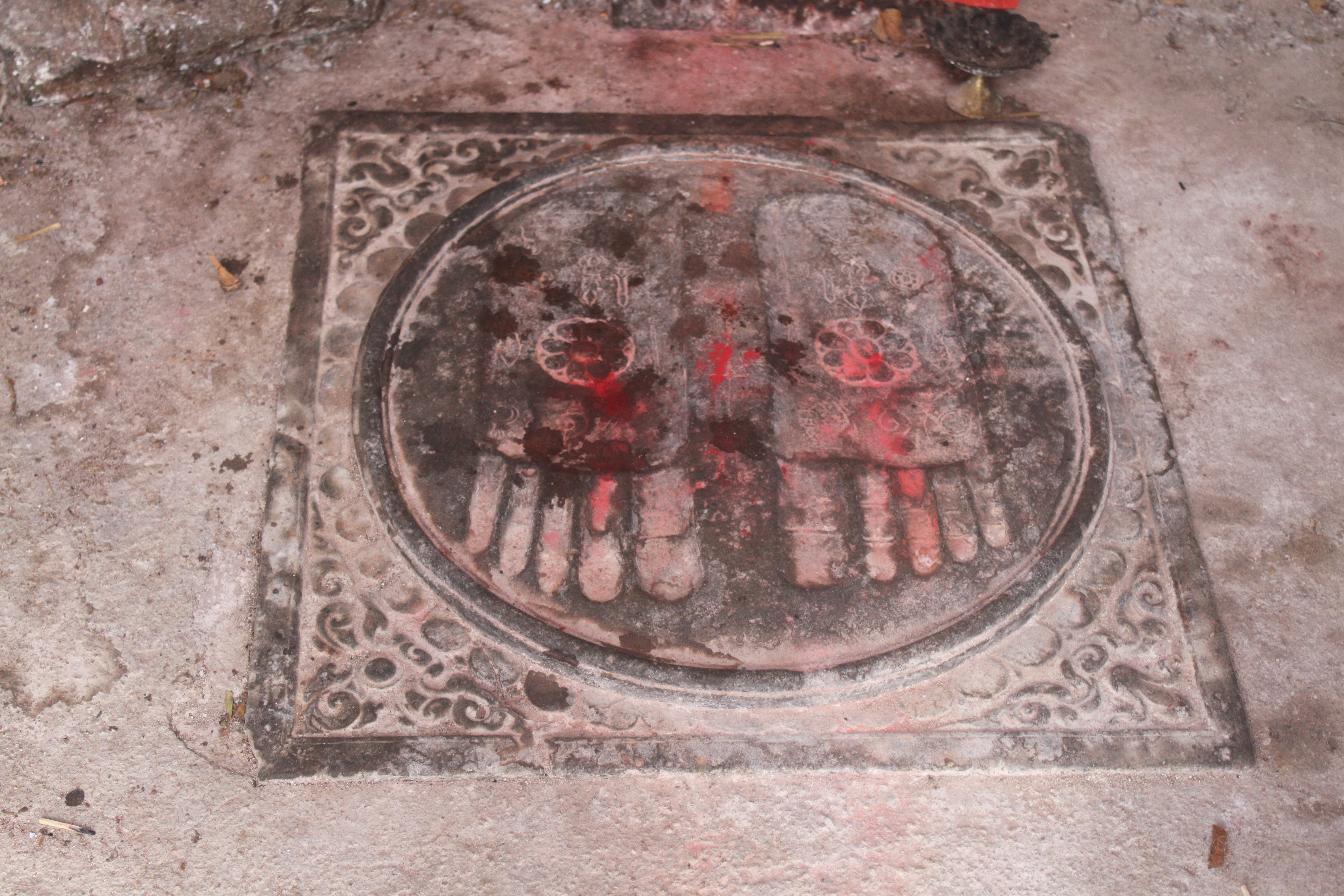
| Ancient sculpture of the ‘Footprints of Mahākassapa’, Kukkuṭapādagiri. |
 |
| New Stūpa, Kukkuṭapādagiri. |
 |
| Archaeologist R. D Banerji. Wikipedia. |
Unfortunately what happened to the skeleton is unknown. Shri Gupta who informed Banerji about the discovery of the skeleton was unaware of what happened to the skeleton and the covering stone (Banerji 1906: 81). Mr F.E. Cockshott who was the District Engineer in charge of the construction of Gya-Barakar (Railway) Extension (Doyle 1905: 105) was unaware of the significance of the Gurpā Hill. There was some confusion about the location of Kukkuṭapādagiri before 1906. Alexander Cunningham in 1871 proposed Kurkihāra as Kukkuṭapādagiri (Cunningham 1871: 14-16). Auriel Stein in 1901 proposed Harsa Kol Hill as the probable site of Kukkuṭapādagiri (Stein 1901: 88). Both the identifications offered by Cunningham and Stein were found to be not convincing. The identification of Gurpā Hill as the Kukkuṭapādagiri/Gurupāda of Buddhist literature was finally settled after R.D. Banerji visited Gurpā Hill in 1905. But, by then it was already too late. Mr Cockshott visited Gurpā Hill before 1905. Unaware of the significance of the place he probably disposed of the skeleton or left it unprotected. As implausible as it may seem, the vulnerable, unguarded sacred skeleton of Mahākassapa eventually succumbed to the negligence by the surroundings living in oblivion.
Story Chronicled by Deepa Nandi
Bibliography:
Banerji, Babu Rakhal Das.; 1906, An account of the Gurpa Hill in the District of Gaya, the probable site of the Kukuṭapādagiri. Journal and Proceedings of the Asiatic Society of Bengal Vol-II, No.1. Calcutta: Asiatic Society.
Baroni, Helen. J.; 2002, The Illustrated Encyclopedia of Zen Buddhism. New York: The Rosen Publishing Group.
Beal, S.; 1869, Travels of Fah-hian and Sung-Yun, Buddhist Pilgrims from China to India. London: Trubner and Co.
Chhabra, B. C.; 1985, “Kasyapa Image Inscription from Silao''. Epigraphica Indica. Vol. 25. Edited by N. P. Chakravarti. New Delhi: Archaeological Survey of India.
Cunningham, A.; 1871, Archaeological Survey of India. Four Reports Made During the Years 1862-63-64-65, Vol. 1. Shimla: Government Central Press.
Doyle, Pat, C.E.; 1905, Indian Engineering: An Illustrated Weekly Journal. Vol XXXVI From July to December 1904. Calcutta.
Esposito, Monica.; 2016, Facets of Qing Daoism.Paris: University Media.
Huard, Athanaric.; 2020, The end of Mahākāśyapa and the encounter with Maitreya Two Leaves of a Maitreya-Cycle in Archaic TB. Tocharian and Indo-European Studies, 2020, 20, pp.1-82. ⟨hal-03500015⟩
Lagirarde, Francois.; 2006, The Nibbana of Mahakassapa the Elder: Notes on a Buddhist Narrative Transmitted in Thai and Lao Literature. Buddhist Legacies in Mainland Southeast Asia. hal-01955848.
McBride, Richard D., & Cho, Insung.; 2016, Shifting Contexts of Faith: The Cult of Maitreya in Middle and Late Silla. The Eastern Buddhist, 47(1), 1–28. https://www.jstor.org/stable/26799792
Rongxi, Li.; 1996, The Great Tang Dynasty Record of the Western Regions. California: BDK America, Inc.
Stein, M. A.; 1901, “Notes on an Archaeological Tour in South Bihar and Hazaribagh”. Indian Antiquary. Vol. 30. Edited by Richard Carnac Temple. Bombay: Education Society’s Press.
Strong, John. S.; 1983, The Legend of King Aśoka. Princeton: Princeton University Press.
Watters, Thomas.; 1905, On Yuan Chwang’s Travels in India. Edited by T. W. Rhys Davids and S.W. Bushell. Vol. II. London: Royal Asiatic Society.