Saṅkāsya (also Sankisa, Sankassa) is one of the ‘Eight Great Places’ of the Buddhist pilgrimage. It is situated in the Farrukhabad district of Uttar Pradesh. It was in Sankisa that the Buddha (6th BCE) performed the miracle of the ‘Descent from the Heavens, accompanied by Indra and Brahma’. In 1842, British explorer and archaeologist, Alexander Cunningham, identified the village of Sankisa as Saṅkāsya of Buddha’s times based on the descriptions of Buddhist monk-scholars Faxian (Fahien 5th CE) and Xuanzang (Hsüan-tsang 7th CE). Besides identifying the place with the help of its name, which remained the same since Buddha’s times, Cunningham discovered an Elephant Capital of Emperor Ashoka (3rd BCE) in a pit near the mound called the Bisāri Devi (also Bisāriyā Devi) in Sankisa.
It is a general belief among the Buddhist pilgrims visiting Sankisa that Bisāri Devi mound is the actual place where the Buddha descended from Tushita (Tayastiṃsa) heaven. The sandstone Elephant Capital of Ashoka's Pillar which today is kept in a stone canopy and the information board by Archaeological Survey of India (ASI) near Bisāri Devi mound reinforce this perception.
 |
| Elephant Capital of Ashokan Pillar kept under a Canopy at the Bisāri Devi complex. Pic @ Rudra. |
In subsequent visits to Sankisa in 1862 and 1876, for exploration and documentation of Sankisa, Cunningham was told that the Elephant Capital which was discovered near Bisāri Devi mound was originally from Kilah mound 200 mts further northwest i.e. the present Sankisa village. Hence the present village of Sankisa (Kilah mound) is the actual place where the Buddha descended from Tushita Heaven.
My objective with this foot journey is to create awareness so that pilgrims who visit Sankisa and offer prayers and offerings at the Bisāri Devi mound also visit the Sankisa village - the actual place where the Buddha made his ‘descent from the heaven.’
Significance of Saṅkāsya in Buddha’s Life
According to Buddhist literature, in the seventh year after his Enlightenment (DA.i.57), on the full moon day of Asālha (in July), the Buddha following the performance of the Twin Miracle at Śrāvasti - he went up to Tushita (Tayastiṃsa) Heaven and passed the rainy season retreat teaching Abhidharma (Abhidhamma) to his mother Māyādevi, who had died seven days after Buddha's birth and been reborn as a male god in Tushita heaven. Three months later, when the Buddha descended from heaven, a great assembly of kings and people of the eight kingdoms gathered. As he descended, a staircase of gold appeared. The Buddha climbed this down accompanied on the right by Brahma and on the left by Indra holding a jeweled umbrella. The descent of the Buddha took place on the day of the Mahāpavārana festival.
 |
The Buddha descending from Heaven. Bhikkhuni Uttpalavarnī in front to welcome The Buddha.
sketch @ Prafull Sasane |
Identification of Saṅkāsya in the 19th century
Sankisa and other Buddhist pilgrimage places in the Gangetic plains continued to flourish or survive as important Buddhist pilgrimage places until the first millennia. At the turn of the 2nd millennium, the practice/ritual of Buddhist pilgrimage in the Indian subcontinent came to an ebb due to a change in the political climate. In the next few centuries, the abandoned Buddhist monasteries, temples and stūpas fell into ruin. As centuries passed, the brick structures got buried under piles of earth. The people from the surrounding villages settled over the remains of the sacred places.
Until the beginning of the 19th century, the history of the origin of Buddhism in India remained unknown to the world because most of the oral and written traditions of the Buddha had got lost or corrupted in its land of origin. Translation of Buddhist texts in the 19th century in the countries of Sri Lanka, Burma, Nepal, China and Tibet region helped in tracing the origin of Buddhism to India. Translations of the works of Faxian in 1836 and Xuanzang in 1853 brought to light a lot of information especially about the existence of a pilgrimage called ‘In the Footsteps of the Buddha’ which they had themselves undertaken.
Alexander Cunningham identified the village of Sankisa as the place Saṅkāsya mentioned by Faxian or Kapitha mentioned by Xuanzang. Although Cunningham identified Sankisa in 1842, it was not until the end of 1862 that he found the opportunity of examining the ruins of Sankisa in depth.
Discovery of the Elephant Capital at Sankisa
Cunningham discovered an Elephant Capital made of sandstone about 400 feet (120mts) to the north of the Bisāri Devi mound (see map). Both Faxian and Xuanzang mentioned the existence of an Ashokan Pillar near the temple where the Buddha had descended from heaven. The discovery of Elephant Capital near the Bisāri Devi mound by Cunningham led him to believe that the Bisāri Devi mound was the place where the Buddha descended from heaven.
 |
| Ancient remains of Sankisa plotted by Alexander Cunningham in 1862. |
 |
| Bisāri Devi mound. Pic @ Vikash |
During his visit to the region in 1862, when Cunningham inquired with the locals about the original find spot of the Elephant Capital, they showed him an octagonal pit situated on Kilah (fort) mound about 200mt northwest from the Bisāri Devi mound (see map). Cunningham noticed the village of Sankisa was situated on a mound. This mound was 41 feet (13mt) in height above the fields. It measured 1,500 feet (450mt) in length from west to east and 1,000 feet (320mt) in breadth. The mound consisted of two parts - the western part of the mound which was very high and prominent known among locals as Kilah (fort), and the eastern part where most of the village was settled.
 |
| Bisāri Devi temple on the top of the mound. |
Locals told Cunningham that the Elephant Capital was found on this Kilah from where it was moved to the Basri Devi which is where Cunningham saw it. Cunningham surveyed the octagonal pit on the Kilah mound and found it damaged at the foundation probably from robbing of bricks. Based on these new findings, Cunningham changed his opinion about the Bisāri Devi mound being the place where the Buddha descended from heaven. In his notes, Cunningham writes: ‘the mound on which the village (Sankisa) now stands would almost certainly be the site of the great monastery with its three holy staircases.’
Faxian and Xuanzang’s Description of Saṅkāsya
Cunningham’s view is convincing to me that the Kilah mound (or the present Sankisa village) is the place where the Buddha made the ‘Descent from Heaven.’ This can be confirmed further from the accounts of Faxian and Xuanzang both of whom mention that a large walled monastery complex, inside which was the 70 feet (21mt) high staircase at the spot where the Buddha had descended from heaven. At the top of the staircase was a temple with a stone image of the Buddha which, according to Faxian, was 16 cubits tall (probably 7mt). Close to the staircase was an Ashokan Pillar 70 ft (21mt) high. Near the Pillar were numerous stūpas and temples enclosed in a walled campus.
Following are the descriptions of the numerous stūpa and temple structures by Xuanzang and Faxian:
- Not far from the Stairs was a stūpa where four past Buddhas sat and walked up and down
- The Buddha bathed immediately after his descent, and later a bathing house and stūpa were built to mark that site. It was beside the place of four past Buddhas.
- Beside this was the temple where the Buddha had gone into samādhi.
- Beside the temple was a large stone platform 50 paces long and 7ft high where the Buddha had walked up and down.
- On both sides of the platform were small stūpas erected by Brahma and Indra.
- In front of this was the place where Bhikkhuni Uttpalavarnī wishing to be first to see the Buddha on his descent from Heaven transformed into universal sovereign.
 |
| Xuanzang at the 'Temple of Descent'. Sketch by Prafull Sasane. |
From the description of the stūpas and temples, it can be inferred that so many big structures could not have existed on the Bisāri Devi mound as it measures only 25ft X 30ft X 30ft. Instead, the Kilah mound (the village of Sankisa) is big enough to have so many structures and therefore most likely to be the place where all these stūpas and temples exist (buried) including, most importantly, the ‘Temple of Descent.’
If the Sankisa mound can be explored properly in future, it would yield a wealth of information to resolve conclusively the question of where exactly the Buddha descended from heaven. In any case, currently, the Buddhist pilgrims seem to be ignorant about the real spot of the descent of the Buddha from heaven, and consequently, during pilgrimage to Sankisa, the whole focus of Buddhist devotees lies on the Bisāri Devi temple.
 |
| Sankisa village settled over the Kilah mound. view from south direction. pic @ Surendra Talwar |
 |
| Sankisa village settled over the Kilah mound. view from west direction. pic @ Surendra Talwar |
Current Situation of Ancient Sankisa
The appearance of the mound has not changed much since the time of Cunningham’s survey but the mound has undergone a lot of damage on all the sides. Cunningham had noted that the north and west slopes of the Kilah mound were steep while the slopes on the remaining faces were gentler. This remains the same. On my foot journey, I visited the village of Sankisa and asked locals about the octagonal spot mentioned by Cunningham. They responded with blank expressions - they had absolutely no clue of what I was talking about.
I was told by locals that people from neighbouring villages have been praying at Bisāri Devi for prosperity and good harvest since very ancient times. A small temple dedicated to Bisāri Devi is situated on the top of the Bisāri devi mound 25ft (7mt) high made up of solid brick. It is presently believed that Bisāri Devi mound is an ancient Buddhist stūpa.
When Cunningham inquired with villagers as to how the Elephant Capital traveled from Kilah to Bisāri Devi mound, they could not answer. Cunningham made a guess that the villagers had planned to take the Elephant Capital to Mahādeva temple located further south of Bisāri Devi mound but left it midway at the Bisāri Devi mound.
During my previous visits to Sankisa in 2017, 2018 and 2019, I had met two persons, Shri Raghav Dixit and his uncle Awadhesh Dixit. Their forefathers did remarkable work in the decades of the 1960’s, 70’s and 80’s to revitalize the heritage of Sankisa. Shri Mukta Prasad Dixit, father of Shri Awadhesh Dixit, along with a Sri Lankan monk Panditha Madabawita Wijesoma Thero established an organisation in 1957 for revitalisation work called ‘Sankasya Development Board’. Despite their limited resources, they constructed a small Buddhist temple inside the Bisāri Devi compound and initiated the trend of celebrating Buddha Jayanti (Vesak Pūrṇimā) annually. The endeavours of the Sankasya Development Board unfortunately came to a halt due to lack of cooperation from government authorities and because of the passing away of Panditha Madabawita Wijesoma Thero and Shri Mukta Prasad Dixit.
On my foot journey, I met with the Dixit family - Awadesh and Rajkumar Dixit ji - who told me that the significance of the mound of Sankisa actually predates the Buddha. They told me that according to Hindu mythology, in the treta yug (Ramayana period), this was where the palace of the brother of King Janak, father-in-law of Rama was situated supposedly. Later, Sankisa acquired an added sacredness as the place where the Buddha descended from Tushita Heaven. The antiquities from the treta yug to the Buddha times are all buried underneath the Sankisa village. Awadhesh ji said that his father Shri Mukta Prasad Dixit had collected lots of antiquities including stone sculptures, terracotta coins and seals from the village and the surrounding mounds. These antiquities are still in their possession. They are willing to donate it to the government if the government would build a museum at Sankisa. Their only condition is that the museum should be named after their father who did so much for the revitalization of Sankisa.
 |
| In conversation with Dixit brothers, Sankisa village. Pic @ Rudra |
At the time of Cunningham, Sankisa was a ‘small village’, settled on the top of the mound (i.e. Kilah). Since the time of Cunningham’s visit, the village Sankisa has grown manifolds. There are now 4000-4500 people in the village of which one-third belong to the community called Dixit Brahmins. Houses on the Kilah are so numerous that they completely envelop the mound. The people of Sankisa know very well that their houses are situated on some kind of ancient remains because they keep discovering large bricks and antiquities anywhere, they dig. But they suppress any discussion about this because they fear that the government may want to acquire the land for exploration or conservation and therefore remove them from there. This is the main reason why antiquities discovered by locals are left unreported and so obviously their whereabouts are also not known. Lack of awareness among the locals has led to apathetic behaviour towards the sacred Kilah mound. People are not hesitating to dig, remove bricks and antiquities, construct houses and perform other activities which are damaging to the mound. One can see collections of ancient bricks in streets. I am afraid that we are slowly losing this sacred and historical treasure. In my interaction with the locals during previous visits, I felt that a few of them were aware that Buddhist antiquities and monuments may not be limited to the Bisāri Devi complex but be spread over the entire village of Sankisa and in that case, every house in Sankisa is standing over ancient Buddhist remains.
 |
| Village Sankisa settled over the mound. Pic@ Vikash |
 |
| Village Sankisa settled over the mound. Pic@ Vikash |
 |
| A villageman showing ancient bricks unearthed from beneath his house. Pic@ Vikash |
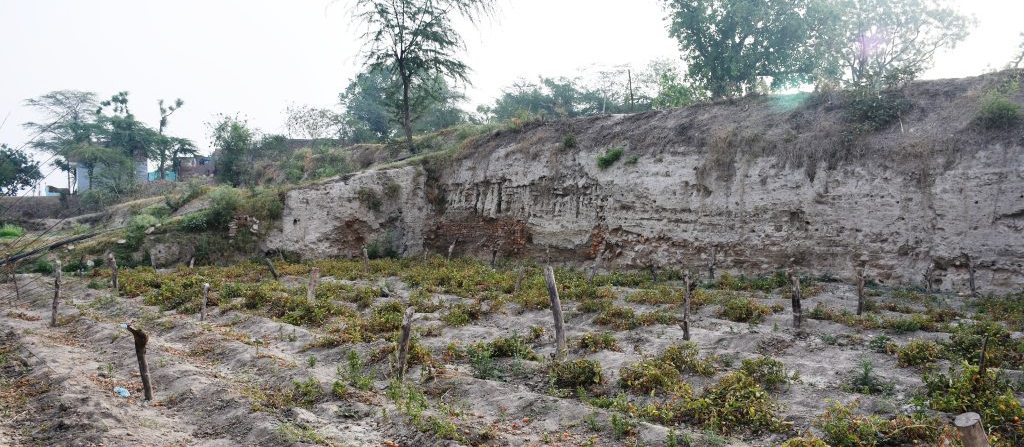
Many ‘stūpa’ mounds which Cunningham noted in 1862 during his visit to Sankisa are in deplorable condition today. For example, Cunningham recorded seeing three ‘Stūpa’ mounds on the opposite side of the road on a mound locally called Nivi-ka-kot. The mound is an agricultural field today. He also saw two stūpa mounds - one on the northeast and the other on the southeast corner of the Nivi-ka-kot. These two mounds were victims of mining of earth, wrote Cunningham. I observed the same - it seems mining has been going on unabated since the 19th century at this site. South of the temple of Bisāri Devi, at a distance of 200 feet, Cunningham had seen a small mound of ruins which he thought were remains of a Stūpa. During my foot journey, I believe I spotted this cluster of ruins at the spot described by Cunningham but it was not possible for me to make out if they were remains of a stūpa because they were damaged beyond recognition due to mining of earth.
Shri Suresh Bauddha, President of the Youth Buddhist Society of India, who is actively involved with the Sankisa Buddhist site, thinks that the Archaeological Survey of India (ASI) is to blame for the vandalisation of these ancient remains. Mining of earth from the sacred mounds is happening in connivance with the local police and hence it is well within the powers of ASI to request the government to stop the mining. In the last decade alone, we have lost many mounds.
 |
| With Suresh Baudh and filmmaker Surendra Talwar at Kārewar Nāga Devtā. |
Suresh ji discussed with me about the presence of two boundaries which is also documented by Cunningham: (1) A ‘central boundary’ 2 miles long enclosing the Kilah i.e. the ‘central portion of the city of Sankisa, comprising the citadel and the religious buildings that were clustered around the three holy staircases’ (see map). (2) The central mound or Kilah mound (i.e. present Sankisa village) was surrounded by the ancient city of Sankisa having a 3.5 miles long earthen rampart around it. Suresh ji told me that the two boundaries are called locally as antarik parikota (inner boundary wall) and bahri parikota (outer boundary wall). “Every year we are losing these ancient boundary walls because of mining. Soon, it will be all flat land,” Suresh ji said.
 |
| Outer boundary and Inner boundary of the Sankisa village and other antiquities plotted on Google Earth image. |
Faxian and Xuanzang have both written about a white-eared Cobra snake which lived close to the monastery, guarding it and the surrounding areas. Faxian also talks about the abundant rainfall and agricultural produce, and prosperity and happiness of the people, all brought about by blessings of the white-eared dragon (Cobra snake). Monks and lay people worshiped this dragon. Grateful for its kindness, the people made a house for the Cobra and a carpet for it to sit on. Every day three monks would go to the Cobra’s house and eat there. Xuanzang mentions the existence of a tank at this place called Nāga Tank. Nāga (Cobra snake) according to Xuanzang was also safeguarding the sacred traces of Saṅkāsya. During his exploration of the region in 1862, Cunningham noticed that this tradition was still alive with a slight variation. The village had an ancient mound called Kārewar Nāga Devtā and the tank mentioned by Xuanzang was now called Kāndaiya Tāl. Cunningham observed that milk was offered to the Kārewar Cobra during each day of the month of Vaisākh (month of May) and on the occasion of Nāg-panchami in the month of sāwan (spring) (July-August). These sacred traces - the Nāga Tank and the dwelling place of the Nāga - are in a village named Chacaunapur which has around 200 households belonging to the Lodhi Rajput community. I have been visiting this village for the last three years. The Kārewar Nāga mound has a 4ft (1.2mt) sandstone pillar which is worshiped as Shiva Linga by locals. In recent years Buddhist pilgrims have started visiting the place which some local monks promote as the place associated with Sāriputra, one of the prominent disciples of the Buddha. During my last visit in November 2019, I noticed many ancient terracotta sculptures lying in the open near Kārewar Nāga. I collected them and handed them over to the villagers for keeping in safe custody.
 |
| Cobra worship by Venerable monks and nuns at Sankisa |
 |
| Collecting precious antiquities lying in the open for safe custody. Chacaunapur. Pic @ Vikash |
 |
| Precious antiquities kept in open in Chacunapur. Pic@ Vikash |
On my foot journey, in the village of Chachunapur, I met Abhilakh Singh and his son Alok Singh who told me that the villagers keep discovering many kinds of antiquities from the fields. People from the cities come to purchase these antiquities ready to pay any price quoted by the villagers. This is clearly indicative of the immense historical and economic value of these items as well as of the possibility of their being trafficked abroad to fetch even higher prices for the buyers. Smuggling of antiquities is extremely common. It is going on unabated at all the ancient sites in India.
Abhilakh ji and like him many villagers are proud of the fact that their village is situated within the bahri parikota (outer boundary) i.e. the sacred zone of Sankisa. They are hopeful that someday Sankisa would develop as a sacred site: Is sthan ka mahatva hai, jo badla nahi ja sakta hai (This place holds a sanctity which cannot be erased.)
 |
| Alok and Abhilaqh Singh in village Chachunapur. |
Efforts at Revitalisation
I have had the opportunity to work with the Light of Buddha Dhamma Foundation International (LBDFI). In 2018 and 2019, during their annual Dhammayatra (Dhamma pilgrimage), the International Mahasangha of LBDFI circumambulated the Kilah mound (i.e. Sankisa village), walked in the streets of the village and chanted Buddhist prayers. The International Sangha also visited the Kārewar Nāga and Kāndaiya Tāl and offered prayers there. The International Mahasangha of LBDFI also had the opportunity to interact with the local community in Sankissa. The people of Sankisa and Chacaunapur welcomed all of us very enthusiastically. I think that pilgrim-community interface is one of the most effective ways to facilitate awareness generation and a sense of collective responsibility towards common heritage. Buddhist pilgrimage guides, interpreters and tour operators should make it a point to incorporate community-pilgrim interface into their Buddhist pilgrimage itinerary.
 |
| Venerable Sangha of LBDFI Circumambulating Sankisa Village (Kilah Mound). 2019. Pic. @ Vikash |
 |
| Venerable Sangha of LBDFI offering prayer at Kāndaiya Tāl. 2019. Pic. @ Vikash |
The village of Sankisa is settled over the ancient remains of the main shrine where the Buddha made his descent from Heaven. Unfortunately, this main shrine is the most neglected monument out of the ancient remains which form a part of the Buddhist pilgrimage to the Eight Great Places. At the other of the Eight Great Places - Śrāvasti, Sārnātha, Vaiśālī, Lumbīnī, Rājagriha etc - the ancient remains whether temples, monasteries or stūpas have been excavated and conserved by the ASI.
I asked Suresh ji as to why efforts had not been made to acquire the land and excavate the sacred stūpas and temples related with the descent of the Buddha from heaven. According to Suresh ji, the main temple which Xuanzang mentions as the ‘Temple of Descent’ cannot be excavated because it is buried right under the village of Sankisa but many of the other ancient mounds in the neighbouring area can be excavated, if the ASI wishes, because these mounds are already under the ownership of ASI. Suresh ji had a document showing 13 plots in Sankisa owned by ASI. Suresh ji wants to engage the Buddhist groups in India and in other countries to buy all the sacred land within the 3.5mile bahri parikota (outer boundary wall) so that the entire area may be excavated, revealed and developed in a proper way. In 2016, Suresh ji had the opportunity to meet the then Chief Minister of Uttar Pradesh, Shri Akhilesh Yadav, and discussed these plans with the Minister but nothing could materialize.
Suresh ji is working towards raising awareness locally and internationally about the sacred traces of the Buddha in this region by organising Buddhist events, conferences, talks etc. He is planning an annual Dhamma Walk between Atranji Kherā and Sankisa. According to both Pali literature and Xuanzang, these two places are associated with the wanderings of the Buddha. They are 70 kms apart. A three-day Dhamma Walk from Atranji Kherā to Sankisa touching the different villages enroute will help in raising awareness about these places internationally. I expressed to Suresh ji that his idea was very good and convincing. I added that the first step in this direction should be the construction of a Pradakhshina Patha (circumambulation path) around the Sankisa village - the actual place where the Buddha descended from Heaven. Let us make this obscure and neglected place a living heritage.
Story chronicled by Aparajita Goswami
Bibliography:
Cunningham, A.1871. The Ancient Geography of India - I: The Buddhist Period. London: Trubner and Co.
Cunningham, A.1871. Archaeological Survey of India. Four Reports Made During the Years 1862-63-64-65, Vol. I. Shimla: The Government Central Press.
Cunningham, A.1880. Archaeological Survey of India. Report of Tours in the Gangetic Provinces from Badaon to Bihar in 1875-76-77-78, Vol. XI. Calcutta: Office of the Superintendent of Government Printing.
Laidlay, J. W. 1848. The pilgrimage of Fa Hian: from the French ed. of the Foe koue ki of MM. Remusat, Klaproth, and Landresse; with additional notes and illustrations.Calcutta: J. Thomas, Baptist Mission Press.
Watters, Thomas. 2004. On Yuan Chwang’s Travels in India. Edited by T. W. Rhys Davids and S.W. Bushell. New Delhi: Low Price Publications.
DA.=Sumangala Vilāsinī, 3 vols. (P.T.S.)